No Interest if Paid in Full in 6 Months
Rates range from 17.99% – 24.99% APR.
Promotional period — interest waived if you pay the full balance within 6 months of approval.
Plan 2601
Apply Now →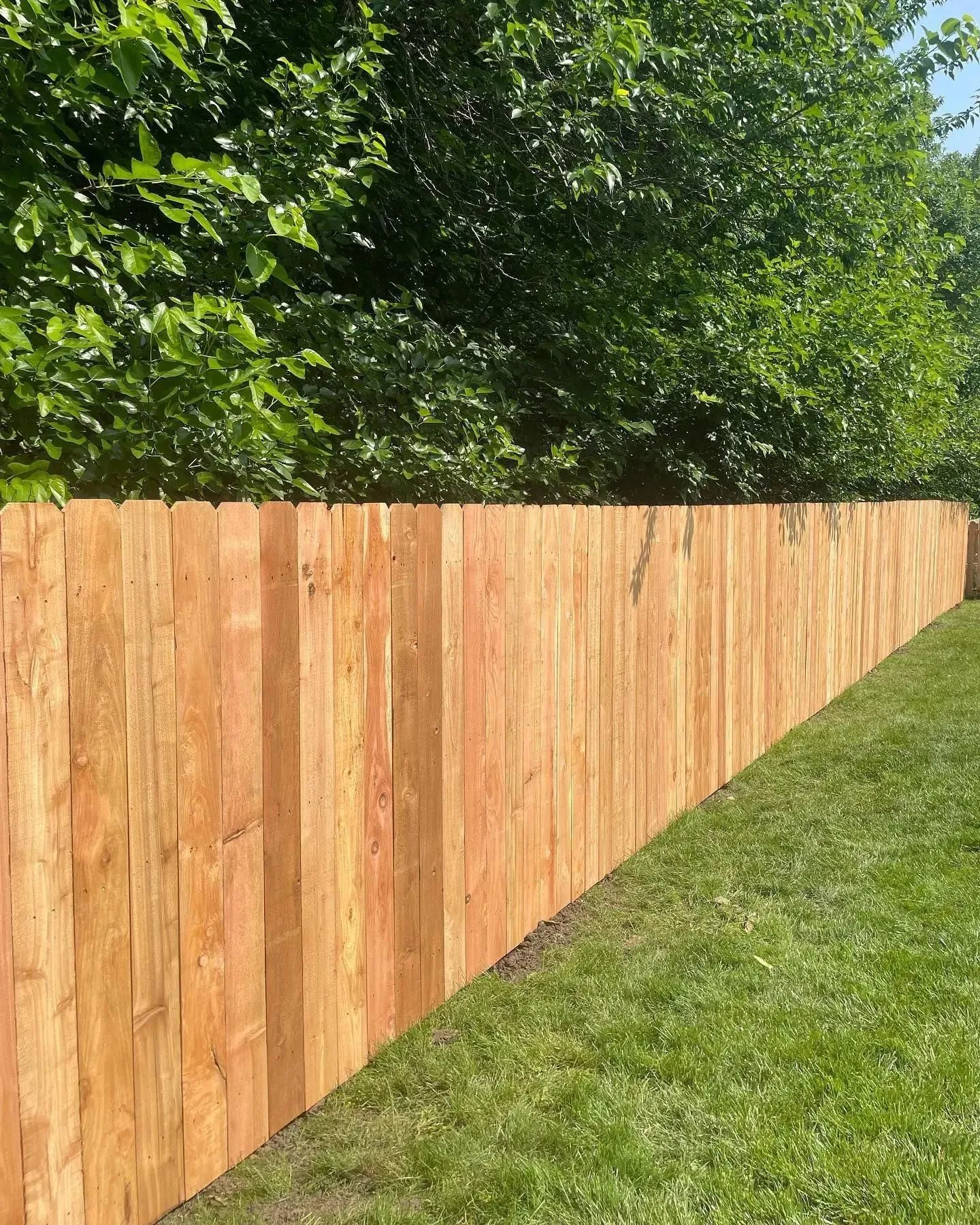
RESOURCES · KC FENCE GUIDES
Cedar, vinyl, chain link, or ornamental iron — a practical side-by-side for KC metro homeowners, including HOA compatibility and real installed costs.
The wrong fence material costs you twice — once at install and again when it fails in seven years instead of twenty-five. Kansas City's soil, climate, and HOA landscape narrow the realistic options for most homeowners before aesthetics enter the conversation. This guide covers what actually matters for KC conditions, not what sounds good in a national comparison chart.
The short version: cedar is the default for good reason, vinyl is gaining ground in newer developments, chain link works where HOAs don't prohibit it, and ornamental aluminum is the right call for pool fencing and open-style greenbelt lots. Everything else is a refinement of those four.
Answer these four questions and your material choice will usually be obvious before you've looked at a single product photo.
Western Red Cedar is the most-installed fence material across the Kansas City metro because it handles the specific combination of challenges KC throws at wood: clay soil drainage, 80+ annual freeze-thaw cycles, and 50+ days of 25+ mph winds. Cedar's natural oils resist rot and insects without chemical treatment. Its tight grain takes stain color evenly, which matters in HOA subdivisions with approved stain lists.
Board-on-board privacy is the dominant style — alternating pickets on both sides of the rail give you full privacy from both directions, and the airflow gap reduces wind sail effect on long exposed runs. Shadow box is required by deed restrictions in some Olathe and Overland Park subdivisions. Dog-ear picket is the most budget-accessible option.
What cedar costs in KC: $22–$35/LF installed for a standard 6-foot board-on-board privacy fence. That includes select-grade cedar, 4×4 posts set 36 inches deep in poured concrete, galvanized hardware, permit, and cleanup. Shadow box and premium profiles run $28–$38/LF. Pressure-treated pine runs $18–$28/LF — the same structure but construction-grade lumber with a 90-day wait before staining.
The one thing cedar requires that vinyl doesn't: a staining schedule. First coat 30 days post-install (for cedar — 90 days for pressure-treated), then every 2–3 years. We include a written stain schedule on every wood fence invoice. Our complete staining guide covers timing, products, and what happens when you skip a cycle.
When to choose cedar over vinyl.
You want the warmth and curb appeal of natural wood. You're in an established neighborhood where vinyl looks out of place. Your HOA requires natural-finished cedar. You're replacing a cedar fence and want material continuity. You're comfortable with the stain schedule.
Vinyl's primary selling point in KC is the elimination of the stain cycle — and for homeowners who won't reliably re-stain every 2–3 years, that's a significant practical advantage over cedar. A properly installed vinyl privacy fence looks nearly identical to painted cedar and requires only a periodic rinse to stay clean.
The important spec distinction for KC: aluminum insert reinforcement is non-negotiable. Cheap vinyl panels without aluminum inserts in the rails and posts fail under KC wind loads — a 6-foot solid-panel vinyl fence is a 48-square-foot sail in a 70 mph derecho. Properly reinforced vinyl with aluminum inserts and posts set 36 inches deep survives KC storm seasons reliably.
What vinyl costs in KC: $28–$45/LF installed for a 6-foot privacy fence. The wider range reflects variation in panel quality — UV-stabilized co-extruded vinyl with aluminum insert reinforcement costs more than basic extruded vinyl, and the difference shows after 5 years in the Kansas sun.
White is the most-common KC color. Tan and gray are gaining ground, particularly in new Olathe and Blue Springs developments where HOAs specify low-maintenance materials. Woodgrain vinyl profiles exist but add cost and aren't substantially better performing than smooth.
When to choose vinyl over cedar.
You want zero maintenance after install. You're in a newer development where the neighborhood aesthetic is modern or neutral-toned. Your HOA approves vinyl in your color. You're a rental property owner who can't count on a staining schedule.
Chain link is the most durable fence material per dollar in situations where aesthetics aren't the primary driver — and in KC, that means rural lots, commercial perimeters, dog runs, and properties outside the Johnson County HOA belt.
The critical KC context: most Johnson County residential HOAs prohibit chain link entirely. If you're in a Cedar Creek, Deer Creek, Lionsgate, or similar subdivision, chain link isn't an option regardless of price. East of I-435 in KCMO, Independence, Blue Springs, and rural Jackson County properties have much fewer restrictions.
9-gauge for residential is standard — heavier mesh, harder to cut or climb than the 11-gauge you'll find at hardware stores. 6-gauge for commercial applications where anti-climb security matters. Vinyl-coated chain link adds a color finish (black or green are most common) and extends corrosion resistance over galvanized-only mesh.
What chain link costs in KC: $10–$18/LF installed for standard 4-foot residential. 6-foot privacy-slat configurations that use chain link as the substrate run higher. Commercial-spec 8-foot anti-climb installations are quoted separately.
Powder-coated aluminum is the dominant ornamental fence material in KC because it's rust-proof, pool-code compatible, and available in styles that satisfy high-end HOA requirements for greenbelt and pond-facing lots. Ornamental steel (wrought iron-style) is the heavier, more expensive option for high-security or commercial applications.
KC HOA context: many Overland Park, Leawood, and Mission subdivisions with pond-facing or greenbelt-backing lots require open see-through fencing — ornamental aluminum is the default specification for these lots. Lionsgate and Deer Creek developments commonly see ornamental aluminum running along the back of properties where privacy fencing is restricted.
Pool code: Kansas City and Johnson County require pool fencing to be non-climbable, 48 inches minimum height, with self-closing self-latching gates. Flat-top aluminum with smooth vertical pickets is the standard KC pool fence solution. All pool fence installs require a permit and city inspection — we handle both.
What ornamental aluminum costs in KC: $25–$45/LF installed for standard residential profiles. Pool-code compatible configurations and premium styles (3-rail, 4-rail) run toward the top of that range. Wrought iron/steel is typically $35–$65/LF depending on specification.
E-coat matters for KC humidity.
Kansas City's humidity and 80+ freeze-thaw cycles degrade powder-coat finishes that weren't properly primed. E-coat primer (electrophoretic coating applied before powder coat) prevents rust from spreading under the finish if it chips. Specify E-coat + powder coat on any ornamental fence in KC.
Wood-polymer composite fencing (Trex Seclusions, TimberTech) looks like stained cedar at ten paces, never needs a stain coat, and carries a 25-year manufacturer warranty. The upfront cost — 40–60% more than cedar — is the only real barrier.
For KC's climate specifically, composite has a meaningful advantage: no moisture absorption. Cedar expands and contracts with KC's freeze-thaw cycles. Composite doesn't. The panels themselves won't heave or warp — though the posts still need to be set 36 inches deep in concrete because frost acts on the post regardless of what panel is attached to it.
What composite costs in KC: $40–$58/LF installed. The 25-year no-maintenance math: if cedar requires a $800 stain job every 2–3 years, that's $3,200–$4,000 in maintenance over a 10-year period. The composite premium for a 150-LF fence is roughly $3,000–$3,500 more upfront. The math breaks even near year 10 and composite wins after that.
Before any material comparison, check your HOA covenants — most Johnson County HOAs have approved material lists that override everything else.
RKC handles architectural review submissions as part of every HOA install. We've submitted to more than 40 KC subdivisions and know which ARBs want color chips in hand vs. a printed swatch. See our HOA fence installation page for the full submission process.
Six materials across nine decision factors — for Kansas City conditions specifically.
| Factor | Western Red Cedar | Pressure-Treated Pine | UV-Stabilized Vinyl | Galvanized Chain Link | Powder-Coated Aluminum | Composite (Trex / TimberTech) |
|---|---|---|---|---|---|---|
| Installed cost (6-ft privacy) | $22–$35/LF installed | $18–$28/LF installed | $28–$45/LF installed | $10–$18/LF installed | $25–$45/LF installed | $40–$58/LF installed |
| Expected lifespan in KC | 15–25 years with staining | 10–15 years | 25–35 years | 20–30 years | 30–50 years | 25–30 years |
| Maintenance required | Re-stain every 2–3 years | Re-stain every 2–3 years (first coat at 90 days) | Annual rinse. No staining. | None beyond periodic inspection. | Annual inspection. Touch up powder coat if chipped. | Soap-and-water rinse. No staining ever. |
| HOA compatibility | Generally approved. Specific stain colors may be required. | Approved in most HOAs. Stain color often required. | Approved in most newer KC HOAs. White, tan, and gray are the commonly approved colors. | Prohibited by most residential HOAs in Johnson County. Allowed in many Jackson County and rural lots. | Approved or required in many high-end HOAs. Pool code compatible. Non-opaque styles often required for front-yard or greenbelt lots. | Approved in most HOAs. Looks like stained cedar from 10 feet. |
| KC climate performance | Excellent — natural tannins resist KC humidity and insects. Post embedment at 36 inches handles freeze-thaw well. | Good — chemical treatment resists rot. First stain waits 90 days for treatment to cure. | Good — aluminum insert rails handle KC wind loads. UV stabilization resists sun bleaching. Some cheaper vinyls crack below -10°F. | Excellent for durability. 9-gauge residential, 6-gauge commercial. Wind passes through the mesh instead of pushing against a solid panel. | Excellent — rust-proof regardless of KC humidity. E-coat plus powder coat survives 80+ freeze-thaw cycles without delaminating. | Excellent — no moisture absorption means no frost heave on posts, no stain cycle, no color fade. |
| Best for | Privacy fences, homeowners who want a natural look and don't mind a staining schedule. | Budget-conscious installs, side yards, secondary fence runs where aesthetics matter less. | Homeowners who want low maintenance. Strong in newer Johnson County developments. | Rural properties, commercial perimeters, dog runs, utility areas. Budget option where aesthetics aren't primary. | Pool fencing, front-yard decorative fencing, greenbelt and pond-facing lots where HOA requires see-through fencing. | Homeowners who want a cedar look with zero maintenance. Long-hold properties. |
| Not ideal for | Homeowners who want truly zero maintenance. | Premium front-yard applications where cedar's cleaner grain is preferred. | Older KC neighborhoods where HOAs prefer the stained-cedar aesthetic. | Any neighborhood with a standard Johnson County HOA. | Full backyard privacy — it's an open picket style, not a privacy fence. | Budget installs — costs 40–60% more than cedar upfront. |
For most KC metro homeowners, the decision path follows a simple tree:
HOA prohibits chain link or specifies cedar?
→ Cedar or vinyl. Pick based on maintenance preference.
No HOA, or HOA allows anything?
→ Chain link for utility/commercial. Cedar for residential curb appeal. Vinyl if you want zero maintenance.
Pool fence required?
→ Ornamental aluminum, flat-top style, 48-inch minimum. No other material passes KC pool code as cleanly.
HOA requires see-through fencing on greenbelt/pond lot?
→ Ornamental aluminum, 2-rail or 3-rail. E-coat + powder coat for KC climate.
Holding the property 20+ years and want zero long-term maintenance?
→ Composite (Trex / TimberTech). Higher upfront cost, no stain schedule, 25-year warranty.
The right answer for your property depends on your specific HOA covenants, lot exposure, and the fence's primary purpose. The on-site estimate is the fastest path to a definitive answer — we measure the property, review your covenants, and give you a written recommendation alongside the cost breakdown.
The on-site estimate includes a material recommendation based on your HOA covenants, lot exposure, and what your neighbors are already installing. Free, no obligation.
Ready when you are